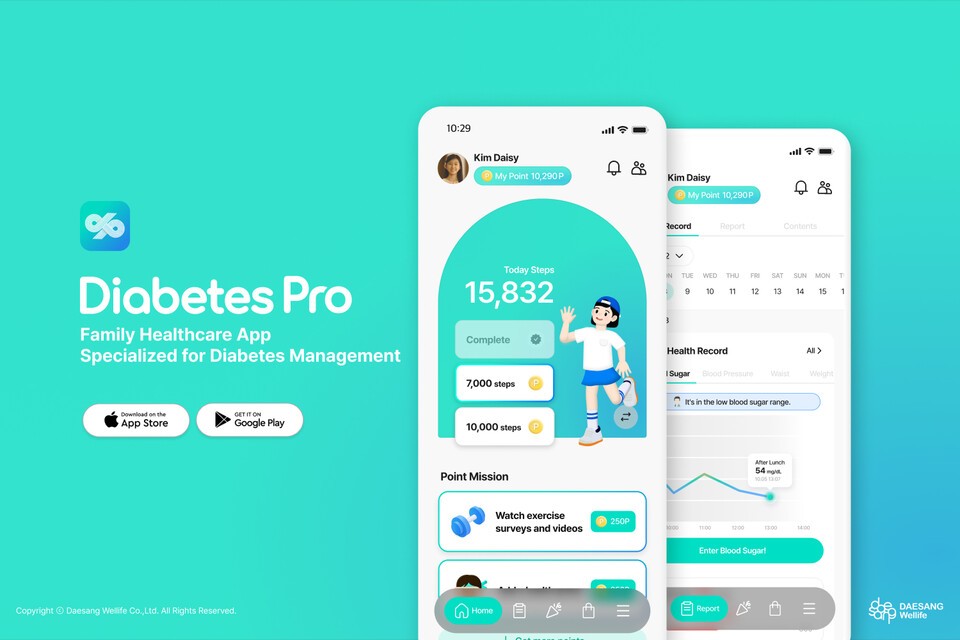
Dangpro is a digital healthcare app built with Daesang, Korea’s No.1 food and wellness company. As the founding product designer, I led the product from scratch - shaping the system logic, UX flows, and design strategy. The challenge: rebuild diabetes care from fragmented tracking into a closed loop of data, action, reward, and family support. Within months, the app reached 100,000+ downloads, positioning Daesang not just as a food company, but as a digital health innovator.
TIMELINE
13 months
(2024.01-2024.12)
ROLE
Founding Product designer (Led product from concept to launch UX, UI, and system logic.)
COLLABORATORS
With Daesang R&D team, nutritionists, Developers, Senior Product Designer
COMPANY
Wala ICT (Client project from DAESANG WELLIFE CORPORATION)
Achievement
Patients and families actively tracked daily health behaviors through a shared diabetes management loop.
Increase in weekly engagement when health data, grocery choices, and family feedback were connected into one flow.
Users reported clearer understanding of how daily habits affected glucose levels, without clinical language.
Product at a glance
A connected health system that turns daily tracking into a continuous care loop
Dangpro connects data, insight, and family support into one continuous ecosystem, turning daily tracking into shared, actionable care. Below is an overview of how each feature, from glucose logging to AI feedback and rewards, all comes together to close the loop between patients, families, and doctors.
Overall mobile APP screeNs
Context
Managing diabetes has become a daily habit, yet most people still do it alone.
Diabetes is no longer a rare condition, it’s part of everyday life. Nearly 1 in 6 adults live with diabetes, and many more are at risk. Managing it means endless micro-decisions: what to eat, how much to walk, when to measure, when to rest. Despite this constant effort, most people still manage on their own, without continuous feedback, connection, or support.
Diagnosed with diabetes
≈ 6 million adults (30+)
At risk of developing diabetes
≈ 15 million adults (30+)
Diabetes management today is more about persistence than connection.
What was the problem?
However, Diabetes care was broken by disconnection, not by a lack for effort.
Every stakeholder was trying, doctors guided, patients logged, families cared, and companies promoted. But without a shared system to connect their actions, effort stayed isolated and progress never looped back.
Doctors
Gave generic advice like “watch your diet” but had no access to patients’ daily data to give meaningful feedback.
Patients
Logged glucose, meals, and exercise every day, but the numbers never turned into insight or motivation.
Families
Tried to support with care and reminders, but without visibility, their support turned into quiet worry.
Company
Promoted wellness campaigns and health foods, but had no bridge to user data or real impact.
Diabetes management today is more about persistence than connection.
Overview
This app was built to close this loop, transforming daily effort into connected, meaningful care.
As the founding product designer, I reframed the product’s goal: from simply recording numbers to driving real behavior change. The design centered around one idea, every effort a patient makes should return as insight, motivation, or tangible value.


Initial misconception
We first approached it as an app, when what we needed was a system.
When I joined, the team was focused on building a better blood sugar logging app, more charts, more logs, more features. But none of it answered a simple question: what actually happens after data is recorded? The early design focused on input, not interpretation, collecting numbers without turning them into meaning or action.
Early prototypes focused on logging, not learning,recording effort without translating it into action.
But during user interviews, patients kept repeating the same thing:
“At least, I keep recording my numbers, but I don’t know what to do next.”

Geunmyeong Park
Type 2 diabetes patient
“Doctors tell me what I should do, but no one shows me how to fit it into my life.”

Jaeyeol Lee
Type 1 diabetes patient
BROKEN SYSTEM → SYSTEMIC SHIFT
The real problem wasn't effort, it was disconnection.
When I mapped the patient’s real routine, I realized the problem wasn’t inactivity - it was fragmentation. Patients, families, doctors, and companies were all doing their part, yet none of their actions talked to each other. Every effort moved in parallel, disconnected from a shared loop of insight, feedback, or reinforcement.
Co-designing
Building the product with the people who use, deliver, and sustain care.
Dangpro wasn’t designed in isolation. To rebuild diabetes care as a continuous system, I collaborated directly with doctors, families, and the partner company. Each stakeholder shaped a different part of the experience — from clinical clarity, to emotional safety, to sustainable engagement. And, their needs became the core architecture of the product.
For Doctors
“I need to see what matters in under a minute.”
We created a one-page clinical summary so doctors can understand key trends and risks within their 3-minute consultation window.
For Family
“I want to help without feeling intrusive.”
We designed lightweight missions and gentle encouragement tools that allow families to support patients without adding pressure.
For Business
“How do we turn health data into engagement?”
We built a reward system that converts healthy actions into redeemable product points, creating a sustainable loop between behavior and business value.
BROKEN SYSTEM → SYSTEMIC SHIFT
We rebuilt the entire care loop so every action now fuels the next.
The redesigned loop synchronizes patients, families, doctors, and the company into a single, self-reinforcing system. Every action—logging glucose, receiving guidance, completing a mission, or offering encouragement automatically triggers the next step in the cycle. What were once isolated habits now function as a coordinated ecosystem that sustains long-term behavior change.
Rebuilt the system
So, how does this system work in real life?
Each feature was designed not as a tool, but as a moment, seamlessly woven into a patient’s daily rhythm. Scroll down to meat Dangpro.
UI Walkthrough - Record
Turning daily records into actionable insight

WITHOUT DANGPRO
Mr. Park logs his blood sugar on paper every day,
but he never knows what’s normal or risky.
No feedback, no motivation, just numbers on a page.
With Dangpro
Now, he can record smarter, not just more.
Mr. Park logs his blood sugar before and after meals,
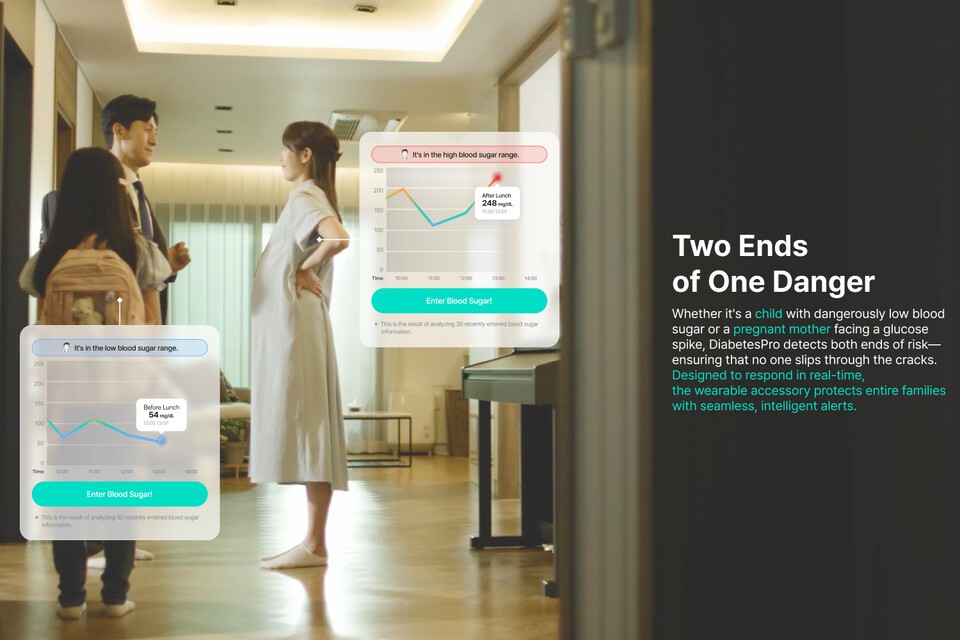
and the app instantly tells him if his level is stable or needs care.
Each record earns 100 points, turning a routine task into steady motivation.
Now, he can see what his numbers really mean.
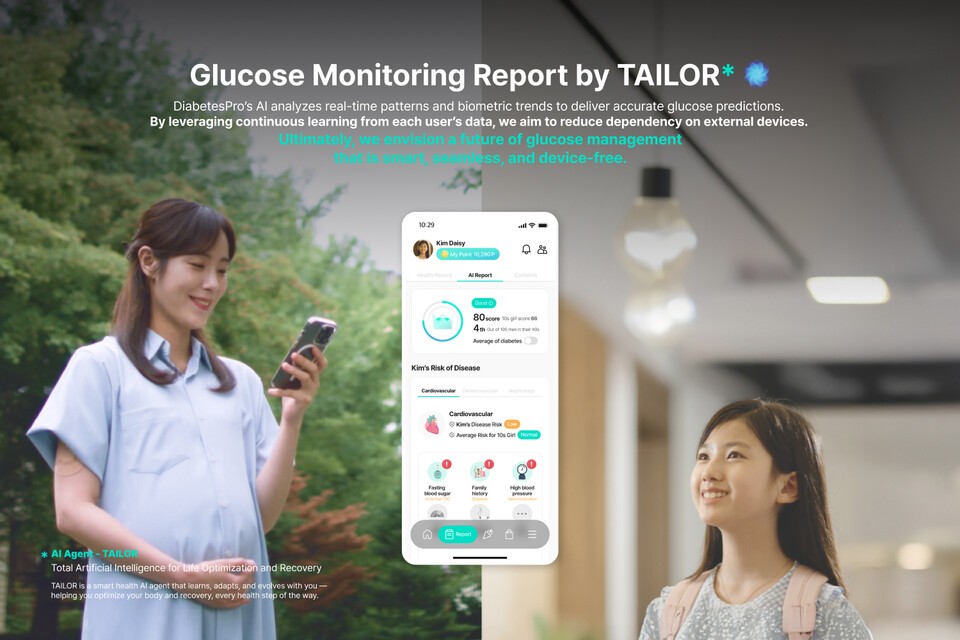
All his records come together in one AI Health Report,
showing trends and risk levels for brain, kidney, and heart health.
For the first time, he understands where he stands and how to improve.
UI Walkthrough - DIET
From Generic advice to actionable/personalized weekly missions
WITHOUT DANGPRO

With Dangpro
Start with a quick diet survey. He answers a few simple questions about portion size and eating habits. This helps the AI understand his usual diet pattern.
Receive weekly AI-tailored missions. Based on his diet data, Dangpro suggests three personalized missions each week, like reducing sugary drinks or adding post-meal walks, each one rewarding small, steady progress.
UI Walkthrough - DIET
From static workout plan to adaptive AI routine
WITHOUT DANGPRO

Before Dangpro
Start with a short activity survey. He answers a few quick questions about his weekly strength training habits.
Get personalized exercise videos instantly. Based on his responses, Dangpro curates workout content by type and intensity helping him stay consistent with routines suited to his condition.
Support
Health becomes a shared effort, not a silent burden.
Before Dangpro

With Dangpro
Shared progress turns into real rewards. Collected points can be used to purchase discounted health products from partnered brands, creating a small but meaningful loop of encouragement and care.
REflection
Looking back, I realized my role naturally expanded beyond the product and into the system around it.
This project showed me that good design doesn’t stop at interface, it continues through behavior, feedback, and trust.